Figuring out how far apart recessed lights should be placed is one of those home design puzzles that can really stump you. You want enough light to brighten the room, but you don’t want it to feel like an airport runway or a surgical suite. Getting the spacing of recessed lights wrong can lead to shadows, hot spots, or a room that just feels off. It’s a common dilemma, and knowing how far apart recessed lights should be is key to a well-lit and comfortable space. Don’t worry, we’re going to break down the rules, the exceptions, and the smart ways to plan your layout.
Why Proper Recessed Light Spacing Matters
The way your recessed lights are spaced can totally transform a room. Too few lights, or lights that are too far apart, will leave you with dark corners and an uneven glow. Conversely, too many fixtures, or fixtures that are too close together, create harsh, overlapping beams and unnecessary glare. It’s all about creating a balanced wash of light that makes your space feel inviting and functional. You’re aiming for even illumination, not a spotlight effect, and the right recessed lights spaced correctly achieve that beautifully.
The Basic Rule of Thumb for Recessed Lights Spaced
Let’s start with the most common guideline for how far apart recessed lights should be: the ceiling height rule. Generally, you’ll want to space your recessed lights at a distance equal to half of your ceiling height. So, if you have an 8-foot ceiling, you’d typically place your lights about 4 feet apart. For a 9-foot ceiling, that’s about 4.5 feet apart, and a 10-foot ceiling would suggest 5 feet between lights. This rule is a great starting point for general ambient lighting. It provides a good balance, ensuring light circles overlap just enough to eliminate shadows without creating glaring hot spots. Keep in mind, this is a general guide, and it’s something we’ll adjust based on other factors.
Expert Tip: Always consider the beam angle of your chosen fixtures. A wider beam (e.g., 60 degrees) will allow for slightly wider spacing than a narrow beam (e.g., 25 degrees) while still providing good light coverage and fewer fixtures. This is a crucial detail many people overlook when planning how far apart recessed lights should be.
Beyond the Rule of Thumb: Factors Affecting How Far Apart Recessed Lights Should Be
While the ceiling height rule gives you a good starting point for how far apart recessed lights should be, it’s just that, a start. There are several other important elements that will influence your final layout. You’ll need to consider the specific purpose of the room, the actual dimensions of the space, the type of fixture you’re using, and any other existing light sources.
Room Function and Purpose
The activity in a room significantly impacts your recessed lights spaced layout.
- Living Rooms and Bedrooms: These spaces often benefit from softer, more diffused ambient lighting. You might follow the ceiling height rule more closely here, aiming for a gentle, even wash. Dimmers are especially important in these rooms to adjust the mood.
- Kitchens: Kitchens need bright, functional task lighting. Over countertops, islands, and sinks, you’ll want your recessed lights spaced closer together to prevent shadows when you’re preparing food. This usually means supplementing the general ambient lighting with dedicated task fixtures or tighter spacing in those specific zones.
- Hallways and Entryways: These areas typically require uniform lighting to guide movement. You’ll want consistent spacing, perhaps a bit closer than the ceiling height rule, to avoid dark stretches.
- Bathrooms: Similar to kitchens, bathrooms need good task lighting, especially around the vanity mirror. General ambient lighting can be spread out, but direct lighting over the mirror is critical.
Ceiling Height and Room Size
We’ve discussed how ceiling height influences the basic spacing, but the overall room size is also important. A very large room might need more fixtures overall, even if the individual spacing between them remains consistent. You wouldn’t want to just scale up the spacing in a huge room, you’d add more rows or columns of lights. For smaller rooms, you might slightly increase the distance between lights if the ceiling height rule feels like too much, but be careful not to create shadows.
Fixture Type and Beam Spread
Not all recessed lights are created equal. They come in different sizes (like 4-inch or 6-inch apertures), and more importantly, they have different beam spreads and lumen outputs.
- Beam Spread: This is how wide the cone of light from the fixture is. A “spot” light has a narrow beam, great for accenting art. A “flood” light has a wider beam, better for general illumination. When planning how far apart recessed lights should be, a wider flood beam means you can space them a little further apart.
- Lumen Output: This measures the brightness of the light. A brighter light (higher lumens) can sometimes allow for slightly wider spacing, but don’t overdo it, or you’ll end up with glaring hotspots.
- Color Temperature (Kelvin): While not directly related to spacing, the color of the light (warm white, cool white) impacts the overall feel. Warmer lights (2700K-3000K) are cozy, while cooler lights (3500K-4000K) are more energizing.
Existing Lighting and Natural Light
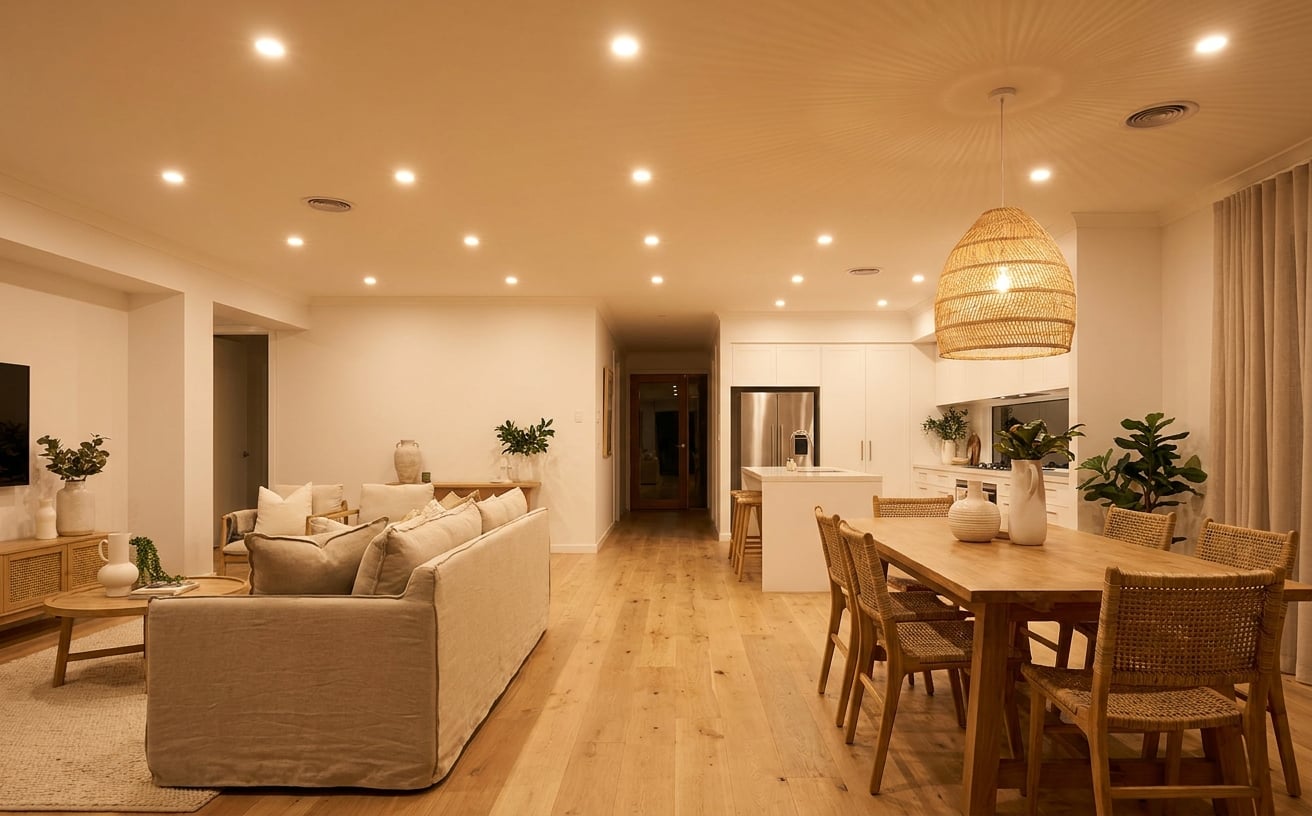
Always consider the light already present in the room. Are there large windows that flood the space with daylight? Do you have floor lamps, table lamps, or pendants that contribute to the overall illumination? These existing sources can reduce the number of recessed lights you need or allow for wider spacing. You’re designing a layered lighting scheme, where recessed fixtures are just one component. You don’t want to over-light a room that already gets a lot of natural light or has several decorative fixtures.
Planning Your Layout: A Step-by-Step Guide for Recessed Lights Spaced
Now that you understand the factors, here’s a practical approach to planning your recessed lighting layout. Taking these steps will help you figure out how far apart recessed lights should be in your specific rooms.
- Measure Your Room: Get the exact length, width, and ceiling height of the space. It’s impossible to plan accurately without these numbers.
- Determine the Room’s Primary Function: Is it a living room, kitchen, bedroom, or hallway? What activities will primarily happen there?
- Sketch It Out (Grid Method): Draw a bird’s-eye view of your room on graph paper or using a simple drawing app. Include doors, windows, and major furniture pieces (like a kitchen island, bed, or sofa).
- Mark Wall Clearances: To avoid harsh shadows on walls or “washing” them out too much, recessed lights are typically placed 2 to 3 feet from the walls. This creates a nice perimeter glow. Don’t put them too close, or it will look odd.
- Calculate Initial Spacing: Use the ceiling height rule (ceiling height / 2) to get your initial spacing estimate. For an 8-foot ceiling, that’s 4 feet. Mark these points on your sketch, maintaining the wall clearance. This gives you your first grid of how far apart recessed lights should be.
- Adjust for Task Areas: Now, look at your task areas. Do you need brighter light over a kitchen island, a desk, or a reading nook? You might add extra fixtures or tighten the spacing in these specific zones. For a kitchen island, you might place lights directly over the island, perhaps 2-3 feet apart, separate from the general ambient grid.
- Consider Dimmers: Always plan for dimmers! They offer incredible flexibility, allowing you to adjust the brightness for different moods or times of day. This is particularly important for general ambient recessed lighting. For anything involving new wiring or modifying existing circuits, I’d strongly recommend hiring a licensed electrician in your area. It’s truly worth every penny for peace of mind and safety when dealing with your recessed lights spaced setup.
Specific Room Examples for Recessed Lights Spaced
Let’s look at a few common scenarios to illustrate how you might approach the distance between recessed lights. Remember, these are examples, and your specific room might require slight adjustments.
Living Room Recessed Lights Spaced
Imagine a 15×20 foot living room with a 9-foot ceiling.
* Ceiling Height Rule: 9 feet / 2 = 4.5 feet spacing.
* Wall Clearance: Place lights about 2.5 feet from the walls.
* Layout: You might have two rows of lights, with 3-4 lights per row.
* Start 2.5 feet from each 15-foot wall, leaving 10 feet in the middle. Place lights at 2.5 ft, 7 ft, and 11.5 ft (or 2.5 ft, 6.5 ft, 10.5 ft, 14.5 ft if using 4 fixtures).
* Start 2.5 feet from each 20-foot wall, leaving 15 feet in the middle. Place lights at 2.5 ft, 7.5 ft, 12.5 ft, and 17.5 ft.
* This would result in roughly 6-8 lights, providing a good, even wash of light. The primary goal for these recessed lights spaced here is creating a comfortable, inviting atmosphere, often supplemented by lamps.
Kitchen Recessed Lights Spaced
Consider a 12×15 foot kitchen with an 8-foot ceiling.
* Ceiling Height Rule: 8 feet / 2 = 4 feet spacing for general ambient.
* Wall Clearance: 2 feet from walls.
* Task Focus: This is key in a kitchen.
* Layout:
* General Ambient: You might have two rows of three lights, spaced about 4 feet apart, with 2 feet from the walls. This handles the overall illumination.
* Task Lighting (e.g., over an island or peninsula): If you have a 6-foot island, you might place two 4-inch recessed lights directly over it, spaced 2-3 feet apart. For countertops, you might place a series of smaller, brighter fixtures (e.g., 3-inch or 4-inch) closer together, perhaps 2-3 feet apart, along the edge of the counter where you’ll be working. You really want to make sure your recessed lights spaced over work surfaces eliminate shadows.
Bedroom Recessed Lights Spaced
Let’s use a 10×12 foot bedroom with an 8-foot ceiling.
* Ceiling Height Rule: 8 feet / 2 = 4 feet spacing.
* Wall Clearance: 2 feet from walls.
* Layout: You’d likely have two rows of two or three lights.
* Place lights 2 feet from the 10-foot walls, then 6 feet in the middle.
* Place lights 2 feet from the 12-foot walls, then 6 feet and 10 feet.
* This setup would give you 4-6 fixtures, providing a soft, ambient glow. Dimmers are essential here. The goal for these recessed lights spaced in a bedroom is typically relaxation, so less intense lighting is often preferred.
Hallway Recessed Lights Spaced
For a 4×15 foot hallway with an 8-foot ceiling.
* Ceiling Height Rule: 8 feet / 2 = 4 feet spacing.
* Wall Clearance: 2 feet from the long walls.
* Layout: You’d usually place a single row of lights down the center of the hallway.
* Start 2-3 feet from each end wall.
* Space subsequent lights about 4-5 feet apart. For a 15-foot hallway, you might have lights at 3 ft, 7.5 ft, and 12 ft, for a total of three lights. The consistency of these recessed lights spaced out evenly is what matters most here.
Common Mistakes When Placing Recessed Lights
Even with the best intentions, it’s easy to make mistakes when planning your recessed lighting. In my experience, the number one error is not fully understanding the room’s purpose and then either under-lighting or over-lighting the space.
| Pros of Proper Spacing | Cons of Improper Spacing |
|---|---|
| Even, comfortable illumination | Dark spots or glare |
| Enhanced room aesthetics | “Airport runway” effect |
| Optimized energy use | Wasted fixtures or insufficient light |
| Flexible lighting options | Unflattering shadows |
Here are a few other common missteps:
- Too Few Lights: This leads to a dim, cave-like feeling with pronounced shadows. People often underestimate how much light is needed.
- Too Many Lights: This can create an overly bright, sterile environment, often with overlapping hot spots that are uncomfortable. It also wastes energy and money.
- Placing Them Too Close to Walls: This creates harsh, unattractive “scalloping” or shadows on the walls themselves. Remember that 2-3 foot clearance.
- Not Considering Task Areas: Ignoring the specific needs of kitchen counters or reading nooks means you’ll still have dark spots where you need light most.
- Not Using Dimmers: Without dimmers, your beautifully spaced lights are stuck at one intensity, severely limiting their versatility.
If you’re shopping for new recessed fixtures, our recessed lighting collection has a range of options at different price points, including various beam angles and finishes, to help you achieve the perfect look and feel for your space.
Frequently Asked Questions
How far should recessed lights be from the wall?
Typically, you should place recessed lights about 2 to 3 feet away from walls. This prevents shadows on the walls and provides a pleasing wash of light into the room without creating harsh “scalloping” effects. Adjust slightly based on your ceiling height and the beam spread of your chosen fixture.
Can you put recessed lights in a sloped ceiling?
Yes, you can definitely install recessed lights in a sloped ceiling. You’ll need special “sloped ceiling” recessed housings and trims that are designed to accommodate the angle. These fixtures will direct the light straight down, even if the ceiling itself is angled.
What size recessed lights should I use?
The most common sizes are 4-inch and 6-inch apertures. 6-inch fixtures are great for general ambient lighting in larger rooms or higher ceilings. 4-inch fixtures are more versatile; they’re excellent for task lighting, accent lighting, or general lighting in smaller rooms and lower ceilings where you want a less obtrusive look.
Do recessed lights need to be centered in the room?
Not necessarily. While it’s tempting to center everything, your recessed lights should be placed based on the room’s function, ceiling height, and furniture layout, not just the exact center. Often, centering them only makes sense if the room is perfectly symmetrical and has no specific task areas.
What’s the best way to determine how far apart recessed lights should be?
The best way is to combine the ceiling height rule (half your ceiling height in feet for spacing) with adjustments for room function, wall clearances (2-3 feet from walls), and any specific task areas. Always sketch out your plan on paper first to visualize the layout before installation.
Getting your recessed lights spaced correctly makes a huge difference in how your home feels and functions. Take your time, plan it out, and you’ll create a beautifully lit space you’ll love. Feel free to explore our extensive collection of recessed lighting options to find the perfect fixtures for your project.