Choosing the right chandelier can feel like a high-stakes decision. You’ve found the perfect style, you love the finish, but then it arrives, and suddenly it’s either swallowed by the room or it feels like it’s eating the ceiling. It’s a common dilemma, and I’ve certainly been there myself, wondering what size chandelier do I need to make this space feel just right. Getting the proportions wrong can throw off the entire look of a room, making it feel unbalanced and, frankly, a bit awkward. But don’t worry, there’s a straightforward design formula that takes the guesswork out of sizing your new chandelier.
The Golden Rule for Chandelier Sizing: Room Dimensions
Let’s start with the most fundamental rule for sizing a chandelier in a general living space like a bedroom, living room, or open-plan area. This formula will give you the ideal diameter for your fixture. It’s incredibly simple and works for most standard rooms.
Here’s how you do it:
- Measure the length of your room in feet.
- Measure the width of your room in feet.
- Add these two numbers together.
- The sum is the ideal diameter for your chandelier, in inches.
For example, if your room is 12 feet long and 10 feet wide:
12 feet (length) + 10 feet (width) = 22.
So, you’d be looking for a chandelier with a diameter of approximately 22 inches.
It’s a really handy starting point, and it’s what designers often use as their baseline. This formula generally ensures the chandelier feels proportionate to the overall footprint of the room. Don’t forget, this is about the diameter, the measurement across the widest part of the fixture.
What About Chandelier Height?
Once you’ve got the diameter, you need to think about the chandelier’s height or drop. For rooms with standard 8-foot ceilings, you’ll want the bottom of your chandelier to be at least 7 feet (84 inches) from the floor. This clearance prevents people from bumping their heads and keeps the fixture from feeling too low.
If your ceilings are taller, you can go a bit higher. For every extra foot of ceiling height, you can add about 3 inches to the chandelier’s hanging height. So, for a 9-foot ceiling, the bottom could be around 81 inches from the floor. Remember, this applies to areas where people walk underneath the fixture.
Dining Room Chandelier Dimensions
Dining rooms are a bit different because the chandelier needs to relate directly to the dining table, not just the room itself. This is where I’ve seen this mistake a lot: people size it to the room, and it ends up looking tiny over a large table, or awkwardly wide.
Here’s the approach for dining areas:
- Chandelier Width/Diameter: The ideal width or diameter of your dining room chandelier should be one-half to two-thirds the width of your dining table. For instance, if your dining table is 42 inches wide, your chandelier should be roughly 21 to 28 inches in diameter. This prevents the fixture from feeling too imposing or too small. It also ensures guests sitting at the table don’t accidentally knock into it.
- Chandelier Height Above Table: This is crucial for both aesthetics and functionality. The bottom of your chandelier should hang 30 to 36 inches above the top of your dining table. This height allows for clear sightlines across the table and provides ample light without glaring into anyone’s eyes. If you have particularly tall family members, you might nudge it closer to the 36-inch mark.
Expert Tip: For very long dining tables, consider using two smaller chandeliers or a linear chandelier instead of one oversized round fixture. This distributes light more evenly and looks much more balanced.
Entryway Chandelier Considerations
The entryway is often the first impression of your home, and a statement chandelier can really set the tone. Sizing here relies on a combination of the room formula and ceiling height.
For the diameter of your entryway chandelier: use the same room formula (length in feet + width in feet = diameter in inches). For instance, an 8×10 foot entryway would suggest an 18-inch diameter chandelier.

When it comes to the hanging height, things get a bit more flexible depending on the space:
- Standard Entryway (no stairs): If it’s a simple foyer where people walk directly under, the bottom of the chandelier should be at least 7 feet (84 inches) from the floor.
- Two-Story Entryway or Over Stairs: This is where you can go much grander. The bottom of the chandelier should still be at least 7 feet (84 inches) above the lowest walkable surface. If it’s hanging over stairs, ensure it’s at least 7 feet above the landing and the top steps. You’ll want to aim for the chandelier to fill the vertical space without looking lost. Often, you can let it hang lower into the volume of the space, as long as it doesn’t obstruct views or walking paths.
For anything involving new wiring or a heavy chandelier, I’d strongly recommend hiring a licensed electrician in your area. It’s worth every penny for peace of mind, especially when you’re working with high ceilings or complex installations.
Living Room and Bedroom Chandeliers
For living rooms and bedrooms, the general room formula (length + width in feet = diameter in inches) is your best friend. These spaces typically have multiple light sources, so the chandelier often acts as an ambient or decorative element rather than the sole light source.
- Living Room: A chandelier here often serves as a central decorative element. Ensure its diameter matches the room formula and that its bottom is at least 7 feet from the floor in walking areas. If it’s positioned over a coffee table, you can sometimes go a bit lower, but still maintain good clearance for standing up from the sofa.
- Bedroom: In a bedroom, the chandelier usually hangs over the bed. This gives you a bit more leeway with height since you won’t be walking directly under it. You can often hang it lower, about 66 to 72 inches from the floor, or roughly 2-3 feet above the mattress. This creates a cozy, intimate feel without hitting your head when you sit up.
When you’re shopping for the perfect fixture, our modern chandelier collection has a range of options at different price points, from sleek and subtle to grand and dramatic.
Ceiling Height and Chandelier Drop
We’ve touched on this, but it deserves its own moment, as it’s a critical factor. The perceived size of a chandelier isn’t just about its width, but also its height and how it hangs in the room.
- Standard 8-Foot Ceilings: The classic 7-foot clearance rule applies. This means a chandelier’s overall height (from ceiling to bottom) shouldn’t be more than about 16-20 inches, depending on the mounting hardware.
- 9-10 Foot Ceilings: You have more vertical space to play with. You can increase the overall height of the chandelier by about 2-3 inches for every foot of additional ceiling height. A chandelier with a longer chain or stem will fill this vertical space beautifully, making the room feel more expansive.
- Vaulted or Cathedral Ceilings: These call for dramatic fixtures. You’ll still want to respect the 7-foot clearance from the lowest walkable floor, but you can choose very tall, multi-tiered chandeliers that fill the apex of the room without overwhelming it. Consider the volume of the space, not just the floor dimensions.
| Pros of Taller Chandeliers in High Ceilings | Cons of Taller Chandeliers in High Ceilings |
|---|---|
| Fills vertical space beautifully | Can be harder to clean and maintain |
| Creates a grand, dramatic statement | Installation often requires scaffolding |
| Prevents fixture from looking ‘lost’ | May require specialized bulbs or parts |
Visual Weight and Style
While formulas give us a great starting point, they don’t account for everything. The visual weight and style of a chandelier also play a huge role in how large it feels in a room.
- Heavy Visual Weight: A chandelier with a lot of dark metal, thick arms, or dense crystals will appear larger and more commanding than its actual measured dimensions suggest. You might choose to go slightly smaller in diameter if your chosen fixture has a very heavy visual presence.
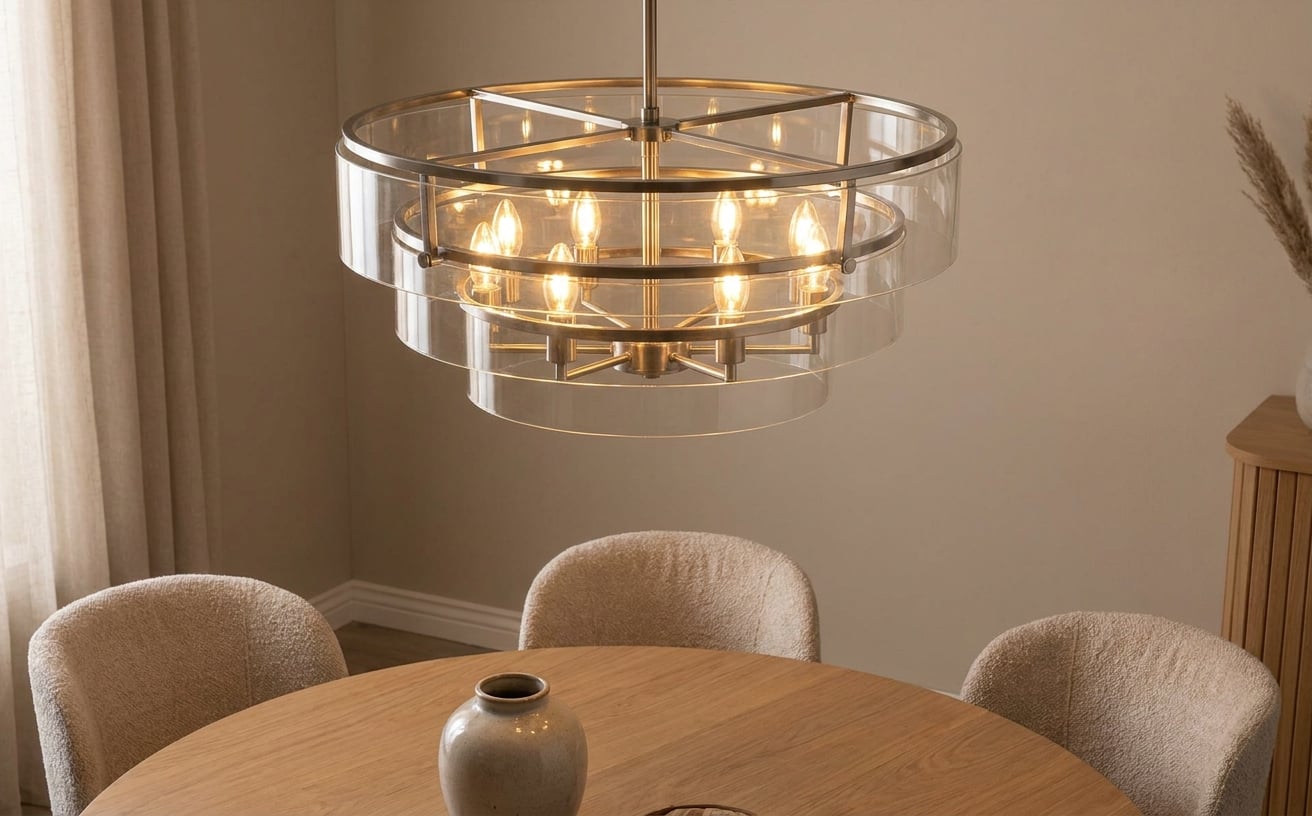
- Light Visual Weight: Conversely, a chandelier with a delicate, open frame, clear glass elements, or thin arms might appear smaller. For these styles, you could potentially size up a couple of inches from the formula’s suggestion if you want it to make more of a statement.
- Open vs. Closed Designs: An open, airy design lets light pass through and can make a room feel more spacious, even if the fixture is large. A more closed, drum-style chandelier with a fabric shade will feel more contained and might appear larger, requiring a more precise adherence to the sizing formula.
In my experience, the number one error is picking a chandelier that’s just too small for the room. People are often intimidated by the idea of a large fixture, but an undersized light can make a grand room feel awkward and disproportionate. Don’t be afraid to go bold within the guidelines!
When to Call in a Pro
You’ve got your measurements, you’ve picked your perfect chandelier, and now it’s time for installation. While hanging a lightweight fixture in an existing box might be a DIY project for some, there are definite times when you need to bring in a licensed electrician.
- New Wiring: If there isn’t an existing electrical box in the ceiling where you want your chandelier, you’ll need new wiring run. This involves working with your home’s electrical system, which is definitely a job for a professional.
- Heavy Fixtures: Chandeliers can be surprisingly heavy. If your fixture weighs more than 50 pounds (and some can be much, much heavier), it requires special bracing in the ceiling to ensure it’s securely supported. A standard junction box isn’t designed for extreme weight. An electrician will know how to properly reinforce the ceiling.
- High Ceilings: Installing a chandelier in a two-story entryway or over a staircase often requires specialized equipment like scaffolding or tall ladders. Electricians have the right tools and training to work safely at these heights.
- Any Hesitation: If you’re ever unsure about the electrical work or the stability of the installation, don’t risk it. Calling an electrician will ensure your chandelier is installed safely and correctly.
Frequently Asked Questions
Can a chandelier be too big for a room?
Yes, a chandelier can definitely be too big. If it’s too wide, it can make the room feel cramped and block views. If it hangs too low, it can obstruct walking paths or glare into your eyes. Following the designer formulas helps prevent these issues.
How high should a chandelier hang in an entryway with a 10-foot ceiling?
For a 10-foot ceiling in an entryway, the bottom of your chandelier should still be at least 7 feet (84 inches) from the floor. This provides ample clearance. You can choose a taller fixture to fill the vertical space more effectively.
What if my room is unusually shaped, like an L-shape?
For unusually shaped rooms, divide the space into common shapes (rectangles, squares) and calculate the ideal chandelier diameter for each section. If a single chandelier is intended for the entire space, base your calculation on the largest, most central area, then consider visual balance.
Do I need a dimmer for my chandelier?
It’s almost always a good idea to put your chandelier on a dimmer switch. This allows you to control the light output, adjusting it for different moods, times of day, or activities, from bright illumination to soft ambiance.
Getting the size right for your chandelier makes all the difference in how your room looks and feels. With these formulas and tips, you’re well-equipped to choose a fixture that perfectly complements your space. Take your measurements, find your perfect style, and enjoy the beautiful glow.