You’ve finally picked out the perfect paint color, found the right furniture, and now it’s time for lighting. But then you look up at your 8-foot ceiling and wonder, “What size flush mount light won’t look silly in here?” It’s a common dilemma, and you’re not alone. Getting the right flush mount size for an 8-foot ceiling isn’t just about illuminating a room; it’s about making the entire space feel balanced and comfortable. Too small, and it’ll get lost. Too big, and it’ll overwhelm the room, making the ceiling feel even lower than it already is. We’re going to break down how to choose the perfect dimensions so your lighting enhances, not detracts from, your home.
Why the Right Flush Mount Size Matters for Lower Ceilings
An 8-foot ceiling is considered standard in many homes, but it doesn’t give you a lot of vertical space to play with. This is precisely why flush mount and semi-flush mount lights are so popular. They sit close to the ceiling, keeping the head clearance open. But even with these fixtures, the diameter and visual weight still need careful consideration. You don’t want a light that feels like it’s taking up too much overhead real estate, making the room feel cramped. Conversely, a tiny fixture in a larger room just won’t provide enough light and will look undersized. It’s all about visual harmony.
The Basic Formula for Determining Flush Mount Size
Let’s get down to the numbers. There’s a widely accepted guideline that can help you determine the ideal flush mount size for most rooms, especially when dealing with an 8-foot ceiling. It’s a simple calculation that considers the room’s dimensions.
Here’s how you do it:
- Measure the length of your room in feet.
- Measure the width of your room in feet.
- Add those two numbers together.
- The sum is the suggested diameter of your flush mount fixture in inches.
For example, if you have a room that’s 10 feet wide and 12 feet long:
10 feet (width) + 12 feet (length) = 22.
So, you’d be looking for a flush mount light with a diameter of roughly 22 inches. This formula provides an excellent starting point for your flush mount size 8 foot ceiling decisions. It isn’t a hard and fast rule, but it’s a very reliable guide.
Applying the Diameter Rule to Common Room Sizes
Let’s look at some practical examples using that formula:
- Small Bedroom (10’x10′): 10 + 10 = 20. A 20-inch diameter flush mount would be suitable.
- Standard Living Room (12’x15′): 12 + 15 = 27. A 27-inch diameter flush mount would fit nicely.
- Larger Dining Area (14’x16′): 14 + 16 = 30. You’d want a flush mount around 30 inches in diameter.
Remember, these are just starting points. If your room is particularly narrow or has an unusual shape, you might need to adjust slightly.
Considering Room Purpose and Layout
While the formula gives you a great baseline, the function of the room is just as important. A kitchen’s lighting needs are different from a cozy bedroom’s.
Kitchens
In a kitchen with an 8-foot ceiling, you’re not just looking for ambient light; you’re also concerned with task lighting. A single large flush mount might cover the main area, but it won’t be enough for countertops or islands.
| Pros of a Single Large Flush Mount | Cons of a Single Large Flush Mount |
|---|---|
| Simple, clean look | Can create shadows on task areas |
| Provides strong ambient light | May feel too dominant visually |
| Easier installation | Not ideal for layered lighting |
Often, a combination of a central flush mount (sized using our formula) and under-cabinet lighting or small recessed lights is the best approach. If you’re shopping for flush mounts, our ceiling lights collection has a range of options at different price points that can work in various kitchen layouts.
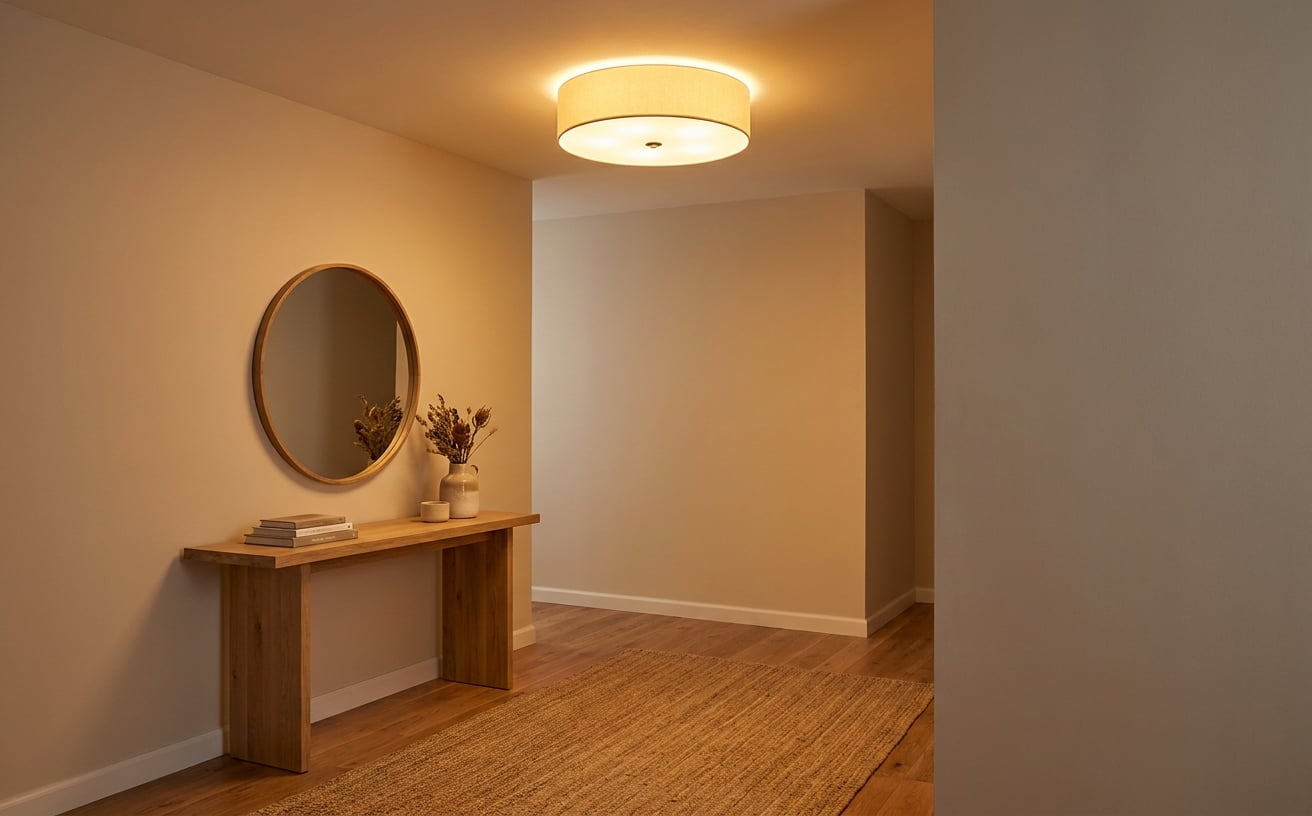
Bedrooms
For an 8-foot ceiling bedroom, a flush mount is often the primary light source. You want it to be functional but also contribute to a relaxing atmosphere. The formula works well here, but you can lean towards the smaller end of the suggested diameter if you have bedside lamps or other accent lights. A diameter of 18-24 inches is often a good range for a standard 10’x12′ bedroom. You don’t want the light fixture to feel like it’s pressing down on you when you’re lying in bed.
Hallways and Closets
These are often smaller spaces where a large flush mount would be completely out of place.
- Hallways: For a typical 3-4 foot wide hallway, you might use multiple smaller flush mounts (e.g., 10-14 inches in diameter) spaced every 6-8 feet, rather than one big one. The goal is even illumination without overpowering the narrow space.
- Closets: A small, simple flush mount (around 8-12 inches) is usually perfect. Focus on brightness and even light distribution to see your clothes clearly.
Expert Tip: For long, narrow spaces like hallways, multiple smaller flush mount lights often look better and provide more consistent illumination than one large fixture. It breaks up the visual line and prevents dark spots.
Visual Weight and Style: Beyond Just Numbers
The physical dimensions aren’t the only factor for your flush mount size 8 foot ceiling decisions. The fixture’s design, material, and how much “visual weight” it carries also play a huge role.
A flush mount with a very simple, sleek design and clear glass might feel less imposing than one with a heavy metal frame and frosted diffuser, even if they have the same diameter.
What Does “Visual Weight” Mean?
Visual weight refers to how much a design element draws the eye and feels like it occupies space.
- Heavy Visual Weight: Opaque materials, dark colors, thick frames, intricate designs, multiple layers. These fixtures tend to feel larger and more dominant.
- Light Visual Weight: Transparent materials (glass, acrylic), light colors, minimal frames, simple shapes. These tend to blend in more and feel less intrusive.
When you’re choosing a flush mount size for an 8-foot ceiling, a fixture with lighter visual weight can often get away with being a couple of inches larger in diameter than one with heavy visual weight, without making the ceiling feel lower.
Installation Considerations and Ceiling Height
While flush mounts are ideal for low ceilings because they sit close to the surface, there are still a few things to keep in mind regarding their actual height and installation.
A true flush mount has little to no gap between the fixture and the ceiling. Semi-flush mounts, on the other hand, drop down a few inches, typically 4-12 inches, on a short stem or chain. For an 8-foot ceiling, you’ll generally want to stick with true flush mounts to maximize head clearance, especially in high-traffic areas. In my experience, even a few inches can make a difference in how spacious a room feels.
For anything involving new wiring, moving an existing electrical box, or installing a very heavy fixture, I’d strongly recommend hiring a licensed electrician in your area. It’s worth every penny for peace of mind and to ensure safety and code compliance. They’ll also know the best way to secure your chosen flush mount size safely.
The Impact of Ceiling Height on Flush Mount Size
Yes, we’re talking about 8-foot ceilings, but even within that, the exact height matters. If your ceiling is exactly 8 feet, you’ll be more constrained than if it’s, say, 8 feet 6 inches. The closer you are to the standard 8 feet, the more critical it is to get the flush mount size right.
If your ceiling is slightly taller than 8 feet, you might have a little more flexibility to go up a couple of inches in diameter if you love a particular design, or even consider a very shallow semi-flush mount. However, for a true 8-foot ceiling, stick to the formula and err on the side of slightly smaller if you’re torn between two sizes.
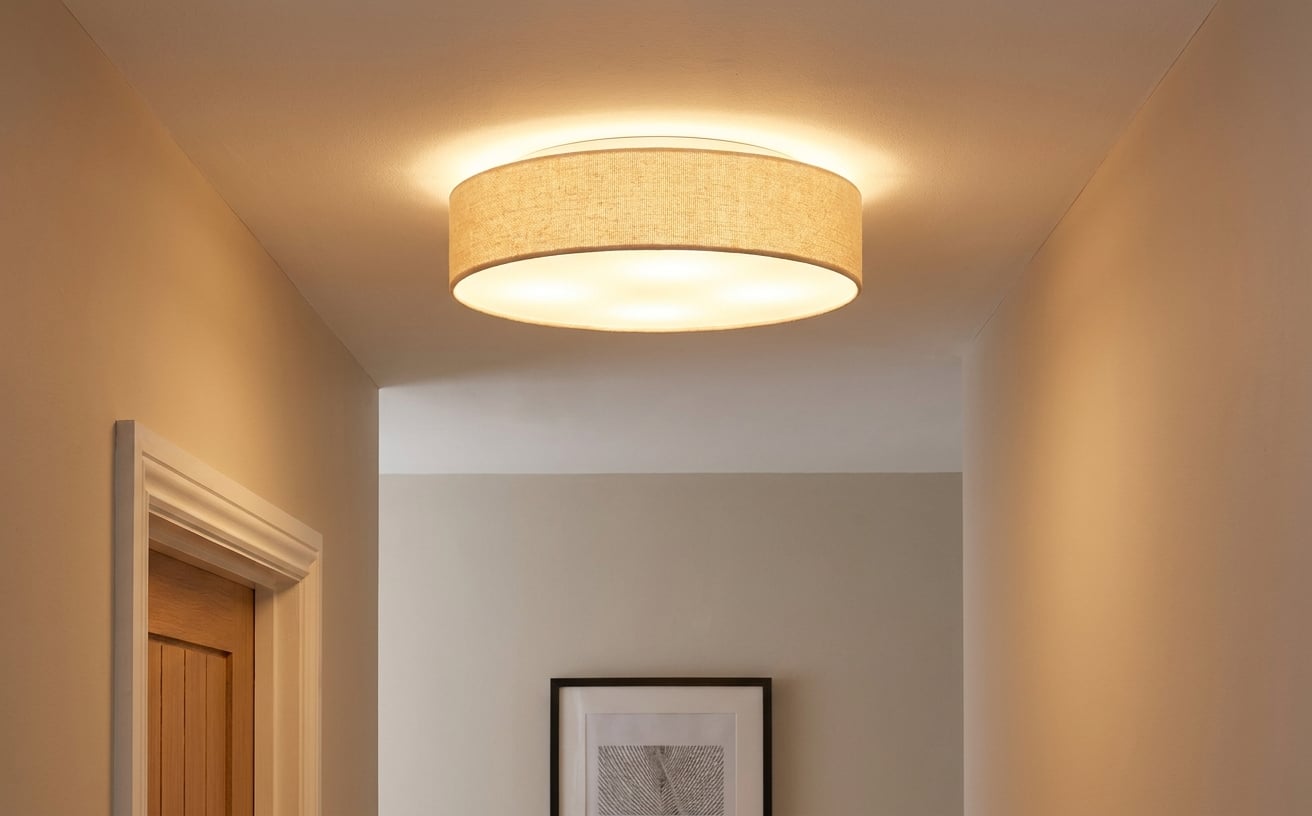
How Many Flush Mounts Do You Need?
Sometimes, one perfectly sized flush mount isn’t enough, or it just doesn’t work with the room’s layout. This is especially true in larger or irregularly shaped rooms.
Instead of trying to find one gigantic flush mount for a very large space, consider using multiple smaller ones. For example, in a 20’x12′ great room (formula suggests a 32-inch diameter), you might find that two 20-inch diameter flush mounts, strategically placed, offer better light distribution and visual balance. This also gives you more control over lighting zones.
Here’s how to think about it:
- Divide and Conquer: For long or very wide rooms, mentally divide the space into zones. Each zone might get its own flush mount.
- Even Spacing: If using multiple fixtures, space them evenly to ensure consistent light coverage. For a hallway, this might mean one every 6-8 feet. For a larger open space, you’ll want to ensure overlapping light cones to avoid dark spots.
- Light Output (Lumens): Consider the total light output. Two 15-inch flush mounts might produce more or less light than one 25-inch fixture. Check the lumens (brightness) of the bulbs or integrated LEDs to ensure you’re getting enough light for the room’s function.
The total amount of illumination is just as important as the physical flush mount size. You don’t want to perfectly size your light only to discover the room is still too dim or too bright.
Frequently Asked Questions
What’s the smallest flush mount light I can use?
For practical purposes, the smallest flush mount lights are usually around 8-10 inches in diameter. These are best suited for very small spaces like pantries, closets, or small powder rooms, or as accent lighting in a larger scheme.
Can I use a semi-flush mount light on an 8-foot ceiling?
It’s possible, but you need to be very careful. A semi-flush mount typically drops 4-12 inches from the ceiling. On an 8-foot ceiling, this means it could hang down to 7 feet or even 6 feet 6 inches, which might impede head clearance, especially in high-traffic areas. Measure carefully, and make sure there’s at least 7 feet of clearance below the lowest point of the fixture.
Does the shape of the flush mount matter for an 8-foot ceiling?
Yes, it can. While the diameter rule generally applies, a square or rectangular flush mount might feel visually larger than a round one of the same width, especially in a square room. Consider the room’s shape and the fixture’s visual weight. A sleek, low-profile square fixture can look great, but a bulky one might feel overwhelming.
How far should a flush mount light be from a wall?
Generally, you want to center the flush mount in the room. If that’s not possible due to a ceiling fan or other fixture, ensure the light is at least 2-3 feet from any wall to prevent harsh shadows and allow light to spread evenly. For multiple fixtures, aim for even spacing that lights the entire area.
What if my room has a low ceiling but is very large?
For very large rooms with an 8-foot ceiling, a single flush mount, even a large one, might not be sufficient or look right. It’s often better to use multiple flush mounts, or combine a central flush mount with other types of lighting like floor lamps, table lamps, and wall sconces to create layered illumination and avoid dark corners.
Choosing the right flush mount size for an 8-foot ceiling is a thoughtful process that balances practical measurements with visual aesthetics. By using the guidelines we’ve discussed, you’re well on your way to creating a beautifully lit and harmonious space. Feel free to explore our extensive collection of flush mount lighting to find the perfect piece for your home.