Choosing the right ceiling fan can feel like a puzzle, especially with so many options out there. It’s not just about picking one that looks nice; you’ve got to consider how it performs in your specific space, how it feels to operate, and how it fits into your home’s overall design. When you’re buying a ceiling fan, thinking through these details beforehand really pays off. You’ll avoid buyer’s remorse and end up with a fixture that truly enhances your comfort and style. I’ve seen this mistake a lot, where people just grab the cheapest or prettiest fan without considering its practical application, and they end up with a noisy, wobbly, or ineffective fan. Let’s dive into what to look for in a ceiling fan.
Size Matters: Blade Span and Room Proportions for Buying a Ceiling Fan
Getting the right size fan for your room is probably the most crucial step in buying a ceiling fan. A fan that’s too small won’t move enough air, and one that’s too big can overwhelm the space and even look awkward. You’ll want to measure your room carefully before you start shopping. It’s not just about the square footage, but also the ceiling height.
Here’s a general guide for blade span based on room size:
- Small Rooms (up to 75 sq. ft.): Think a small bathroom, laundry room, or walk-in closet. A fan with a blade span of 29-36 inches usually works well here.
- Medium Rooms (76-144 sq. ft.): This covers most bedrooms or smaller living rooms. You’ll want a fan in the 36-48 inch range.
- Large Rooms (145-225 sq. ft.): For larger bedrooms, family rooms, or dining rooms, a 48-54 inch fan is typically appropriate.
- Great Rooms/Open Concepts (over 225 sq. ft.): You might even consider two fans, or one large fan with a blade span of 60 inches or more.
Ceiling height also plays a big role. For standard 8-foot ceilings, you’ll need a “hugger” or flush-mount fan to ensure the blades are at least 7 feet off the floor for safety. Taller ceilings, say 9 feet or more, allow for downrods, which bring the fan blades lower into the room for better air circulation. The ideal height for fan blades is usually 8-9 feet from the floor. If your ceiling is really high, you might need a longer downrod, up to several feet.
Motor Quality and Performance: What to Look for in a Ceiling Fan’s Core
The motor is the heart of your ceiling fan, and its quality greatly impacts performance, noise, and energy use. There are two main types you’ll encounter: AC (alternating current) and DC (direct current). AC motors have been around longer and are generally more affordable, but DC motors are becoming increasingly popular for good reason.
DC motors are known for being incredibly energy-efficient, often using up to 70% less energy than their AC counterparts. They’re also much quieter, which is a huge plus in bedrooms or living areas where noise can be a distraction. You’ll find that DC fans typically offer more speed settings and often come with remote controls as standard. While they might have a higher upfront cost, the energy savings and quiet operation often make them a smart long-term investment.
Airflow, measured in Cubic Feet per Minute (CFM), is another key indicator of performance. The higher the CFM, the more air the fan moves. Look for fans with a good CFM rating for your room size, usually listed in the product specifications.
Expert Tip: Don’t just look at the highest CFM rating. Also check the CFM/Watt efficiency number. A fan might move a lot of air, but if it uses a ton of energy to do it, it’s not truly efficient. A higher CFM/Watt indicates better energy performance.
Style and Finish: Integrating Your Fan with Your Decor
Once you’ve got the practical elements sorted, it’s time to think about aesthetics. A ceiling fan isn’t just a utility; it’s a fixture that contributes significantly to your room’s design. The style, finish, and blade material should complement your existing decor, not clash with it.
Consider the overall architectural style of your home. Is it modern, traditional, farmhouse, industrial, or something else?
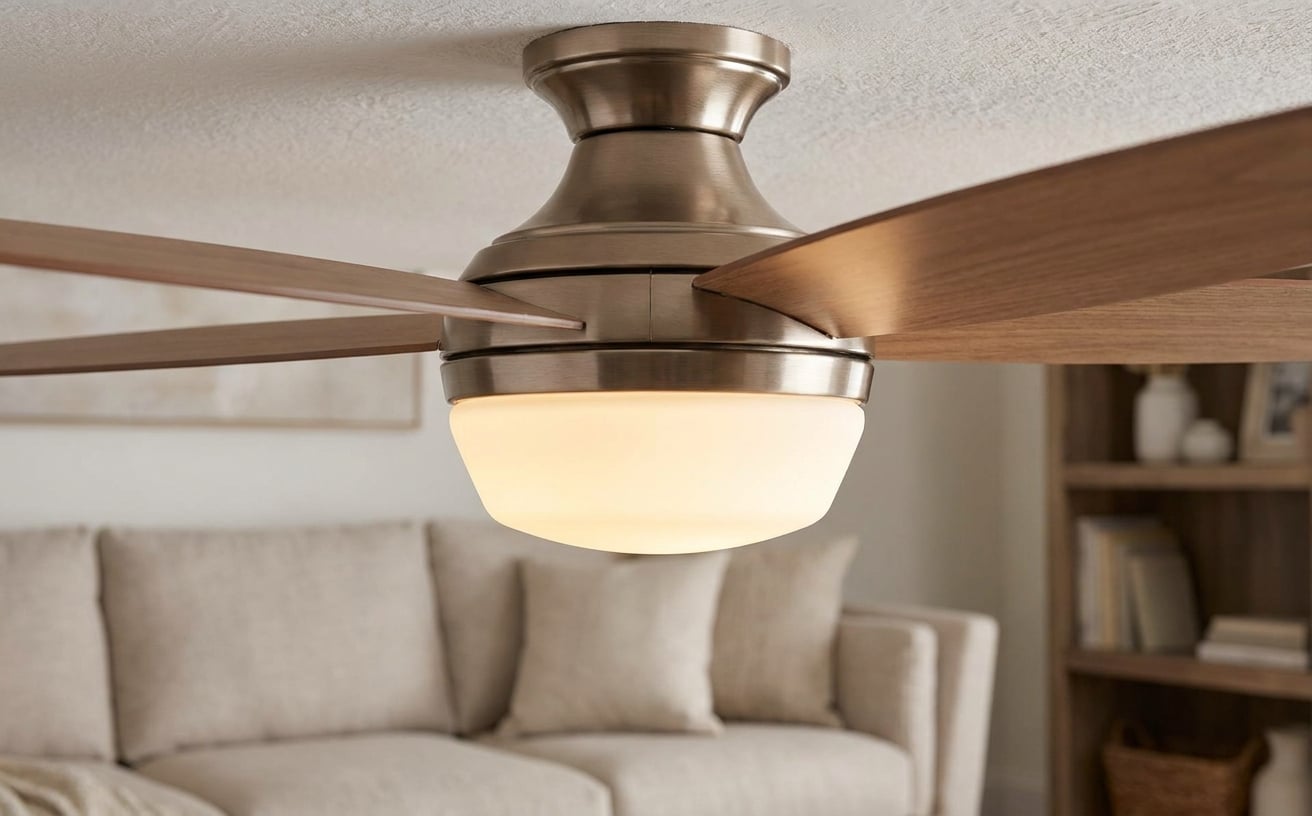
- Modern fans often feature sleek lines, minimalist designs, and metallic finishes like brushed nickel or matte black. They might have fewer blades or uniquely shaped ones.
- Traditional fans usually have more ornate details, often with dark bronze or polished brass finishes, and classic wood-grain blades.
- Farmhouse or rustic fans might incorporate distressed wood blades, oil-rubbed bronze finishes, and simple, sturdy designs.

Blade material also matters. Real wood blades offer a classic, warm look, but they can sometimes warp in very humid environments. ABS plastic blades can mimic wood or metal, are durable, and resistant to moisture, making them ideal for outdoor or damp locations. Metal blades are great for an industrial or contemporary feel, but they can sometimes be noisier. Picking the right finish helps your fan blend in or stand out as a focal point, depending on what you’re going for.
Lighting Options and Controls for Buying a Ceiling Fan
Many people consider the lighting capabilities when buying a ceiling fan, and for good reason. A ceiling fan with an integrated light can serve a dual purpose, saving you from needing a separate overhead fixture. If you’re shopping for a new ceiling fan, our ceiling fan collection has a range of options at different price points, many with excellent integrated lighting.
When considering lighting, look for:
- Integrated LED lights: These are energy-efficient and long-lasting. Many offer different color temperatures (warm white to cool white) and dimming capabilities, which is a fantastic feature for setting the mood.
- Light kit options: Some fans come with a light kit, while others offer it as an add-on. Make sure the light output (lumens) is sufficient for your room.
- No light option: If you already have ample lighting from recessed cans or other fixtures, a fan without a light can offer a cleaner, less busy look.
Control methods are another big decision. You’ll typically find:
- Pull chains: The most basic option, but can be inconvenient in rooms with high ceilings.
- Wall controls: These replace your standard light switch and offer more control over fan speed and light dimming. They provide a clean, integrated look.
- Remote controls: Extremely convenient, allowing you to adjust settings from anywhere in the room. Many DC motor fans come with remotes as standard.
- Smart home integration: Some modern fans can connect to Wi-Fi and be controlled via smartphone apps or voice assistants like Alexa or Google Assistant. This offers unparalleled convenience and scheduling options.
What to Look for in a Ceiling Fan’s Smart Features
If you’re a tech-savvy homeowner, smart features can really enhance your fan experience. Look for fans that integrate with your existing smart home system for seamless control. Some smart fans even have features like adaptive learning, where they can adjust speed based on room temperature or occupancy. These advanced capabilities aren’t for everyone, but they certainly add a layer of convenience and energy savings that traditional fans can’t match.
Installation and Safety Considerations for Buying a Ceiling Fan
Installing a ceiling fan isn’t always a simple DIY project, especially if you’re dealing with new wiring or a heavy fixture. Ceiling fans can be quite heavy, often weighing more than 35 pounds, so they require a securely mounted electrical box that’s rated for fan support. A standard light fixture electrical box won’t cut it. For anything involving new wiring, replacing an old box with a fan-rated one, or hanging a particularly heavy fan, I’d strongly recommend hiring a licensed electrician in your area. It’s worth every penny for peace of mind and to ensure everything is up to code and safe.
Key Aspects of Buying a Ceiling Fan Installation
Consider the type of mounting your ceiling requires:
- Flush Mount (Hugger): For ceilings typically 8 feet high or lower. The fan mounts directly to the ceiling, with no downrod.
- Standard Downrod Mount: Most common, uses a downrod to position the fan blades away from the ceiling for optimal air circulation. Suitable for 9-foot ceilings and up.
- Angled/Sloped Ceiling Mount: Requires a special adapter or bracket to ensure the downrod hangs straight down on a sloped ceiling.
| Pros of Downrod Mount | Cons of Downrod Mount |
|---|---|
| Better air circulation | Can look too low on 8-foot ceilings |
| More decorative options | Requires more clearance from furniture |
| Easier to clean blades | Blades might be harder to reach for short people |
It’s also important to ensure the fan is balanced correctly after installation. An unbalanced fan can wobble, create noise, and potentially put strain on the motor and mounting hardware over time. Most fans come with balancing kits, which include small weights and clips to help you achieve smooth, quiet operation.
Energy Efficiency and Smart Features
Energy efficiency is a big deal these days, and ceiling fans can play a role in reducing your energy bills. Look for fans with an Energy Star rating. These fans are certified to meet strict energy efficiency guidelines set by the U.S. Environmental Protection Agency. An Energy Star fan can use up to 60% less energy than a conventional fan, which can add up to significant savings over its lifetime.
Most modern ceiling fans also come with a reversible motor. This allows you to change the direction of the blades. In the summer, you’ll want the blades to spin counter-clockwise, pushing air down to create a cooling effect. In the winter, reverse the direction (clockwise) to gently pull warm air near the ceiling down into the room, helping to distribute heat more evenly and making your heating system more efficient. This simple feature is really effective and something you shouldn’t overlook when buying a ceiling fan.
Some fans offer advanced smart features beyond basic remote control. This could include:
- Integrated thermostats: The fan automatically adjusts its speed based on the room’s temperature.
- Schedules: Program the fan to turn on or off at specific times, or even adjust speeds throughout the day.
- Vacation mode: Randomly turns the fan on and off to give the appearance that someone is home.
These features not only add convenience but can also contribute to further energy savings by ensuring the fan only operates when and how it’s most needed.
Frequently Asked Questions
How high should a ceiling fan be from the floor?
For safety and optimal air movement, ceiling fan blades should ideally be at least 7 feet from the floor. If your ceiling is 8 feet high, a flush-mount fan is usually best. For taller ceilings, downrods can bring the blades down to 8 or 9 feet from the floor, which is often considered the sweet spot for comfort.
Can I install a ceiling fan myself?
If you’re replacing an existing ceiling fan in a fan-rated electrical box and are comfortable with basic electrical work, it might be a DIY project. However, if you need to install new wiring, replace a non-fan-rated electrical box, or the fan is particularly heavy (over 35 lbs), it’s strongly recommended to hire a licensed electrician. Safety always comes first when dealing with electrical installations.
What’s the difference between AC and DC motors in ceiling fans?
AC (alternating current) motors are traditional, generally more affordable, and reliable. DC (direct current) motors are newer, much more energy-efficient (up to 70% less power), quieter, and often offer more speed settings and come with remote controls. While DC fans can be more expensive upfront, their long-term energy savings and quiet operation are significant benefits.
Do ceiling fans really save energy?
Yes, ceiling fans can absolutely save energy, especially when used correctly. In summer, they create a wind-chill effect, allowing you to raise your thermostat setting by a few degrees without feeling warmer, thus reducing AC use. In winter, running them in reverse at a low speed helps redistribute warm air from the ceiling, making your heating system more efficient.
How do I choose the right blade material for my ceiling fan?
The best blade material depends on your fan’s location and desired aesthetic. Real wood blades offer a classic look but can warp in high humidity. ABS plastic blades are durable, moisture-resistant, and good for outdoor use or damp environments. Metal blades suit industrial or modern styles but can be louder. Consider your room’s climate and design for the best choice.
Choosing a ceiling fan means balancing aesthetics with practical needs. By considering size, motor quality, style, lighting, controls, and installation requirements, you’ll be well-equipped to find a fan that provides comfort and beauty for years to come. Take your time, measure your space, and explore the options to find the perfect fit for your home.